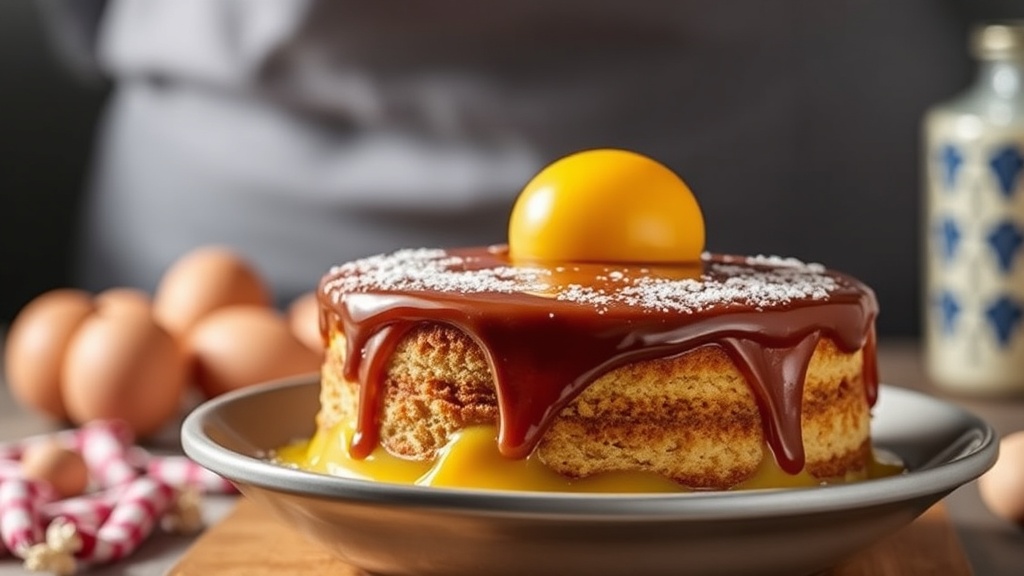
Stop Using Cold Eggs in Your Cake Batter

Have you ever pulled a sponge cake out of the oven only to find it dense, heavy, or strangely oily? The culprit isn't usually your oven calibration or your flour brand—it's the temperature of your eggs. This post breaks down the chemistry of egg temperature, why room-temperature eggs are non-negotiable for emulsions, and how to fix the common mistakes that ruin your batter texture.
Why do I need room temperature eggs for baking?
Using room temperature eggs ensures that the fats and liquids in your batter form a stable, smooth emulsion. When you add cold eggs to a mixture of creamed butter and sugar, the cold liquid causes the fat to seize and curdle. This creates a broken batter that can't hold air, resulting in a cake that lacks lift and feels unpleasantly heavy.
Think about the science of an emulsion for a second. In a standard cake recipe, you're trying to bind fat (butter) with water (the liquid in the egg). If those eggs are straight from the refrigerator, they hit that warm, aerated butter and immediately shock it. The butter turns into tiny, solid clumps. Even if the batter looks "okay" while mixing, those microscopic clumps of fat won't melt evenly in the oven. You end up with a crumb that is uneven and dense rather than light and consistent.
I remember working a line in a small pastry kitchen in Lyon where we didn't just "get away" with anything. If the base was broken, the cake was dead. It's a hard rule for a reason. A broken emulsion is a broken cake.
When the emulsion is successful, the air bubbles you whipped into the butter and sugar stay suspended. These bubbles expand in the heat of the oven, giving you that classic, airy crumb. If the eggs are cold, those bubbles collapse before the structure of the cake can set. It’s a subtle difference, but it's the difference between a professional-grade sponge and a kitchen-table mishap.
A good reference for understanding how proteins and fats behave under different temperatures can be found on the Wikipedia page for Emulsions. It's basic physics, really.
How can I warm up eggs quickly?
The fastest way to warm eggs is to place them in a bowl of warm (not hot!) water for about five to ten minutes. You want to avoid using boiling water or a microwave, as both methods can cook the egg whites prematurely or create a "cooked" flavor that ruins the delicate profile of your batter.
Here are the three most effective methods for bringing eggs to the right temperature:
- The Warm Water Bath: Place your cold eggs in a heat-proof bowl and cover them with lukewarm water. Let them sit for 5-10 minutes. This is the safest method for maintaining the integrity of the egg.
- The Hot Water Trick: If you're in a rush, run your eggs under a warm tap for a minute. It’s not perfect, but it’s better than nothing.
- The Gentle Heat Method: If you have a sous-vide precision cooker, you can set it to a low temperature (around 38°C or 100°F) to bring the eggs to temp without any risk of overcooking.
Don't go overboard with the heat. If you use water that is too hot, you'll actually start the coagulation process of the proteins. You want the egg to be room temperature, not a poached egg. It’s a fine line, but once you get the hang of it, it's easy.
If you find yourself constantly struggling with ingredient temperatures, you might also want to check out my post on why your vanilla extract might be underperforming. Temperature affects everything, including how aromatics behave.
What happens if I use cold eggs in a cake?
Using cold eggs leads to a broken emulsion, a dense crumb, and an unevenly risen cake. The immediate result is a batter that looks curdled or "lumpy" during the mixing stage. This isn't just a visual issue—it's a structural failure that persists even after the cake is baked.
Let's look at the technical breakdown of what happens in the bowl:
| Feature | With Room Temp Eggs | With Cold Eggs |
|---|---|---|
| Batter Texture | Smooth, creamy, and aerated. | Lumpy, grainy, or "broken." |
| Air Incorporation | High; bubbles are stable. | Low; bubbles collapse easily. |
| Final Crumb | Uniform, soft, and light. | Dense, heavy, and occasionally greasy. |
| Rise | Consistent and predictable. | Uneven or stunted. |
When the fat in the butter hits the cold egg, it undergoes a phase change. It goes from a semi-solid, creamy state back toward a solid state. This is why your batter might look like it's separating. You'll see tiny white or yellow flecks of egg and clumps of butter. While you can try to "fix" it by beating it longer, you've already lost some of the air you worked so hard to incorporate during the creaming stage.
It’s a bit like trying to paint a wall with a brush that's too stiff. The medium just won't flow correctly. In baking, the "medium" is your batter, and the "stiffness" is that temperature shock.
If you're curious about the chemical properties of eggs and how they function as leavening agents, the Britannica entry on eggs offers a deep dive into their biological and culinary functions.
The result of using cold eggs is often a "greasy" sensation on the tongue. This isn't because you used too much butter, but because the butter wasn't properly emulsified into the batter. The fat is essentially sitting in pockets rather than being part of a cohesive structure. It's a common mistake, but once you realize why it happens, it's easy to avoid.
I've seen many home bakers get frustrated because they followed a recipe perfectly, yet the cake still felt "off." Usually, it's a failure of temperature control. It’s not just about the ingredients; it’s about the state of those ingredients when they meet. If you're already checking your pantry for quality, you might want to see if your salted butter is actually better for your specific baking needs, as the salt content and temperature of your butter are just as vital as the eggs.
One thing to keep in mind: if you are making a recipe that requires separating eggs (like a sponge or a chiffon cake), the temperature of the whites is even more important. Cold whites are much harder to whip into stiff, stable peaks. A warm egg white has a more flexible protein structure, which allows it to trap air more effectively during the whipping process.
It's the small, technical details that separate a good cake from a great one. Don't let a cold egg be the reason your hard work goes to waste. Take the five minutes to warm them up. Your batter—and your guests—will thank you.