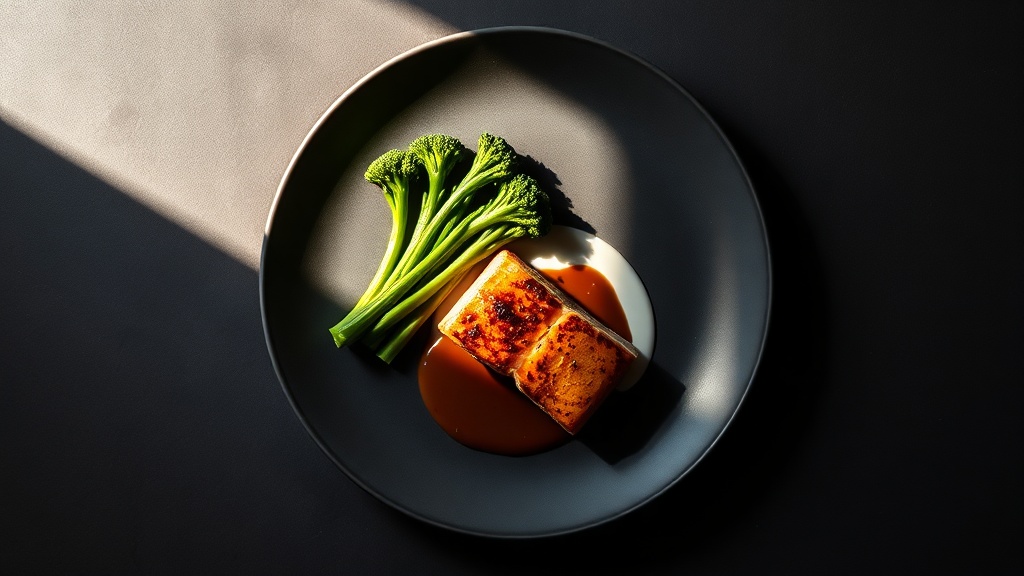
The Rule of Thirds on a Plate: A Photographer's Guide to Plating Weeknight Dinners

A lot of home cooks assume restaurant-looking food starts with expensive ingredients.
It doesn't.
It starts with structure.
I learned this long before I shot food. In architecture, a strong building reads clearly from fifty feet away because the lines make sense. On a plate, the same rule applies: your eye needs a path, a focal point, and breathing room.
If you're cooking for friends this Friday or Saturday, this is the cheapest upgrade you can make. Not a new knife. Not a new pan. Better plating.
1) The Canvas: Your Plate Is Half the Composition
If your plate is too small, everything looks cramped. If it's glossy and patterned, your food loses contrast.
For home cooks, a reliable workhorse is a matte, wide-rimmed plate or bowl in white, bone, charcoal, or muted stone tones.
Why this works:
- A wide rim gives you intentional negative space.
- Matte glaze diffuses reflections, so colors read cleaner.
- Neutral color lets ingredient contrast do the talking.
If you only change one thing this month, change the plate. I'd rather you serve a killer roast carrot and yogurt dish on a calm, matte plate than wagyu on something with a floral border and mirrored shine.
2) The Rule of Thirds: Stop Centering Everything
In photography, the rule of thirds means dividing your frame into a 3x3 grid and placing your subject near an intersection point instead of dead center.
Same on a plate.
Put your main element at roughly 2 o'clock or 7 o'clock, not at high noon in the middle. Suddenly the dish has movement. It feels alive.
Try this quick layout for a weeknight protein bowl:
- Main protein (salmon, chicken thigh, tofu): off-center on one third line.
- Secondary element (veg or grain): balancing opposite side.
- Sauce: connecting the two with one intentional sweep or pool.
This tiny shift creates visual tension, and tension is what makes a plate look designed instead of assembled.
3) Texture as Contrast: Build the "Soft vs Crisp" Dialogue
Architects love material contrast: raw concrete beside warm oak, steel against linen.
Plating needs the same conversation.
If everything is soft, the dish dies visually and texturally. To embrace sensory maximalism, pair a soft base with a crisp accent:
- Potato puree + crispy shallots
- Hummus + toasted seeds
- Risotto + fried sage
- Roasted squash + crunchy pepitas
When I'm composing a plate, I ask one blunt question: where's the crunch?
This isn't garnish theater. Crisp elements catch light differently, give the eye a punctuation mark, and make every bite less monotonous.
4) Purposeful Mess: Controlled Chaos Beats Rigid Symmetry
Symmetry is seductive. It feels safe.
It can also make home-cooked food look like it was trapped in a stencil.
In my own shoots and restaurant meals over the past year, the plates that stick with me are restrained but human: clear focal points, clean layouts, and one imperfect gesture that proves someone made it. You can borrow that at home with controlled chaos:
- Drag sauce with the back of a spoon once, not five times.
- Let herbs land naturally after one deliberate placement.
- Keep one edge rough (crumb, zest, oil drip) so the plate breathes.
Mess without intention is sloppy. Intention without humanity is sterile. You want the middle.
A 5-Minute Plating System for Friday Night
Use this when guests are ten minutes out and you still have onions on your shirt. (If you want to avoid the last-minute scramble entirely, start by upgrading your prep system).
- Choose the canvas: largest matte plate you own.
- Anchor the hero: place protein off-center on a third.
- Add the support: starch/veg opposite for balance.
- Create contrast: one crisp component on top or side.
- Finish with one gesture: sauce swipe, herb scatter, or citrus zest.
- Edit ruthlessly: wipe rim, remove random drips, stop.
That last part matters. A lot of weak plating comes from one extra spoonful, one extra herb pinch, one extra flourish.
Real Example: Tuesday Chicken, Restaurant Mindset
Say you made pan-roasted chicken thighs, lemony white beans, and broccolini.
Here's the composition:
- Spoon beans at 8 o'clock as a soft base.
- Set chicken thigh partly on beans, angled toward center.
- Stack broccolini lightly at 2 o'clock for height and direction.
- Spoon pan sauce in a loose crescent that ties chicken to beans.
- Finish with cracked pepper and a tiny pinch of chopped parsley.
Same dinner. Different read.
Nobody at the table says, "Nice rule-of-thirds execution."
They say, "Why does this look so good tonight?"
Final Frame
A food plating guide should do one thing: make your everyday food look and feel more intentional.
Use these plating techniques and you'll get restaurant-quality presentation without restaurant drama. Whether you are executing a perfect French omelet or a simple roast chicken, the rule of thirds, negative space, contrast, and controlled chaos are not precious chef tricks. They're composition tools.
And composition is free.
This weekend, cook what you already planned. Just plate it like you meant it.