Texture is the New Flavor: Building Sensory Maximalism on a Tuesday Night

I spent my 30s peering through a Leica lens, trying to find the soul in steel, glass, and concrete. I spent a good chunk of my 20s sleeping on flour sacks in cramped European kitchens, learning that a kitchen operates a lot like a construction site—loud, hot, and punishing if you don’t build on a solid foundation.
When I finally traded architectural photography for food, it wasn't a departure. It was a realization: a perfectly composed plate has better bones than a skyscraper. And right now, as we push into 2026, the food world is waking up to an architectural truth of its own. We are finally done with flat food.
Industry forecasters are calling the big trend of 2026 "sensory maximalism." After years of sleek, over-processed, plant-based pucks and convenience meals that felt engineered to be chewed as quickly as possible, we are swinging back. We want texture. We want the loud crunch, the aromatic hit that fills a room, and the kind of multi-sensory experience that reminds us we're alive and eating real food.
Think of it like building a house. For years, weeknight dinners have been all drywall—functional, quick, but entirely devoid of character. Sensory maximalism is about bringing back the exposed brick, the rough-hewn timber, and the polished concrete. It’s about building a dish that has structure.
Let’s talk about the Maillard reaction. Most people know it as the science of browning—that beautiful crust on a steak or the golden edge of a smashed burger. But from an architectural standpoint, the Maillard reaction isn't just about color; it's about structural integrity. When you sear a piece of meat or hard-roast a mushroom until it squeaks, you are creating a load-bearing wall of flavor. You’re building a foundation that can hold up against the deluge of a pan sauce or the sharp spike of a vinaigrette. A $15 bottle of Gamay poured alongside a properly seared piece of protein tastes like a million bucks because the food demands attention. It refuses to be ignored.
You don't need a tasting menu budget to build this way. You just need to think like a line cook on a Tuesday night.
Here is my 10-minute trick for bringing sensory maximalism to the most boring, Thursday-night-staring-into-the-fridge meal: The Facade.
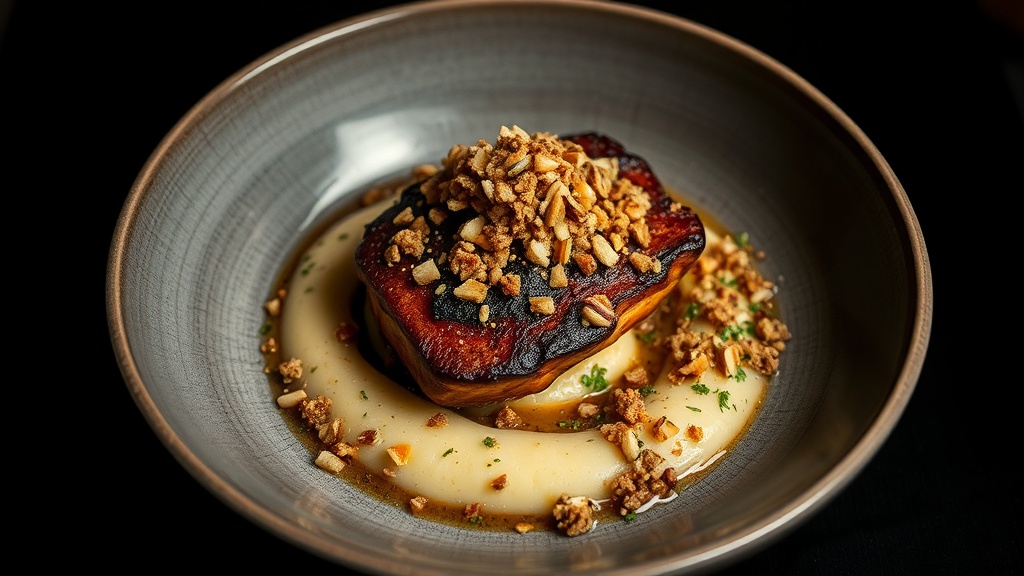
Every great building needs a striking facade, and every great bowl of pasta, roasted chicken, or simple grain bowl needs a textural top layer. I keep a jar of what I call "rubble" in my pantry. It’s a mix of toasted nuts (almonds or hazelnuts), aggressively roasted breadcrumbs, a pinch of flaky salt, and whatever dried herbs I have lying around.
When you plate your dinner—say, a soft, creamy risotto or a piece of braised chicken—you hit it with a handful of that rubble, and maybe a quick spoonful of pickled shallots for an acidic spike.
Suddenly, your mouth isn’t just processing mush. It’s navigating the creamy foundation, the robust, Maillard-browned protein, and the loud, echoing crunch of the facade. You’ve built a skyscraper in a bowl.
We don't need the hush-hush reverence of fine dining to eat well. We just need to remember that eating is a physical act. Build your dinner with purpose. Give it some teeth. Because a meal without texture is just a meeting you have to chew through.