Women Engineered This: The Food Tech Innovations That Actually Changed How We Cook (March 2026)

Alright, let's talk about the engineering—the real innovations behind how we cook.
Not the origin stories. Not the TED talks. The actual technical problems that got solved, and how the solutions ended up on your countertop or in your mise en place. Two days out from International Women's Day, I want to give you something more useful than inspiration: specifics. What changed, why it matters, how to use it.
The Fermentation Problem Was Always a Control Problem
For most of culinary history, fermentation was treated like weather—you could set favorable conditions, but you couldn't truly manage outcomes. Koji (Aspergillus oryzae) cultivation in particular was a craft passed down through feel and instinct: experienced fermenters could read mycelium growth by hand-temperature checks, smell profiles, the look of the bloom. That knowledge transferred badly. A trained eye in Kyoto didn't help a cook in Chicago.
The engineering breakthrough—driven significantly by food scientists and research teams across academic fermentation programs and commercial food science labs—was bringing quantifiable control to the process. Specifically: precision humidity systems targeting the 85–95% RH range that koji mycelium requires, CO₂ monitoring to track metabolic activity as a live growth indicator, and pH telemetry that flags the difference between a clean ferment and the beginning of contamination.
What this unlocked isn't just consistency. It's replicability—the ability to produce koji-fermented proteins (beef, fish, legumes) at home with predictable outcomes. When I first ran a batch through a calibrated chamber, hitting a tight temperature window around 93°F with logged humidity, the result was closer to professional koji house output than anything I'd managed by feel alone. That's not a technique improvement. That's a category shift.
The practical upshot for your kitchen: bench-top fermentation chambers with data-logging capability have become genuinely accessible at the consumer level—verify current pricing before you commit, but the barrier is lower than it's ever been. If you're making garum, amino pastes, or any long-ferment umami project, you're no longer relying on ancestral knowledge you don't have. The data replaces the apprenticeship. That's not cold — that's democratic.
The Knife Handle Is Not a Decoration
I want to be specific here because this gets flattened into aesthetics conversation too often. The engineering problem with professional cutlery wasn't blade steel—it was grip geometry designed around a hand profile that excluded roughly half the population.
Traditional Western and Japanese handle designs were historically shaped around grip assumptions—a specific palm width, a specific thumb-to-index span—that reflected who was using professional knives at the time they were developed. The practical consequence: for hands outside that range, proper pinch grip required either compensatory tension (faster fatigue, reduced control) or an awkward full-grip position that sacrifices blade feedback.
The design work coming out of engineering teams that deliberately applied anthropometric data—not assumed hand dimensions—reframed the problem. Instead of "how do we make a handle ergonomic?" the question became: what's the actual force distribution during a rock chop, a push cut, a tip draw? Finite element analysis of grip pressure, not aesthetic preference. The result, in the better contemporary knives built on this research, was handle geometry with a lower, more forward center of balance and wider tang taper that distributes cutting force across more contact surface.
The functional difference is real. A pinch grip that doesn't require compensatory tension means better feedback from the blade, which means you're actually reading the food while you cut. That's not a comfort feature. That's a precision feature.
Alt-Protein Isn't a Replacement Strategy—It's a New Ingredient Class
The framing around plant-based proteins has been almost entirely nutritional-substitution: can we make this taste like meat? That framing misses the more interesting engineering story.
Researchers in food biochemistry solved specific textural and flavor-binding problems in ways that create entirely new cooking possibilities—not just approximations of old ones.
Take methylcellulose: this polysaccharide gels upon heating and re-liquefies when cooled—the inverse of most gels—which means it can stabilize emulsifications at temperatures where a traditional fat emulsion would break. What does that mean practically? You can build a sauce or filling that holds at braising temperatures through a mechanism animal fats couldn't replicate. That's a new technical capability—not a substitute.
Similarly, precision fermentation of specific flavor compounds (heme-adjacent molecules, specific fatty acid profiles via yeast expression systems) means you can dial in the Maillard reaction products of a protein without the protein itself. I've used precision-fermented soy leghemoglobin in stock bases where I wanted depth without the iron-heaviness of actual blood products. It behaves differently than what it replaces. That's interesting to me as a cook—not because of what it isn't, but because of what it does.
The Scale That Teaches
Data tools for cooking have mostly been bad because they tried to make cooking a program you execute rather than a craft you develop. Follow the algorithm, get the result. The cook who can't feel when a dough is properly hydrated isn't actually learning baking.
The design breakthrough in modern feedback-oriented tools is the shift from instruction to feedback. Instead of telling you what to do, the tool tells you what you're doing.
The best thermal modeling approaches—built from food science research on thermal conductivity variance in proteins—give you a predicted pasteurization curve based on actual initial temp and water circulation rather than a fixed time. You're seeing the cook, not following a recipe. That's a fundamentally different relationship with the data. The precision feeds your intuition rather than replacing it.
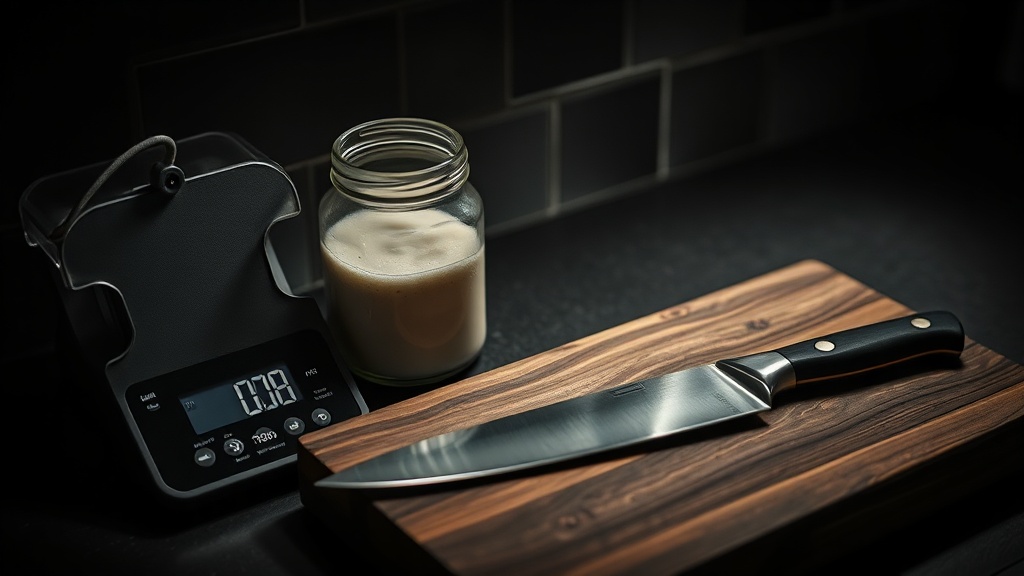
I use a bench scale for every fermentation project that logs humidity and temp readings to a simple CSV. The numbers don't make decisions—I do. But after a few seasons of logged data, I know my kitchen's fermentation microclimate in a way I couldn't have mapped through feel alone. The data compressed years of trial-and-error into something I could actually read.
The Pro-Kitchen Gap Narrowed on Both Ends
Here's the broader point. The innovations above aren't interesting because they exist in professional kitchens—most didn't start there. They're interesting because they moved from research labs to home kitchens without a middle step that stripped out the technical depth.
Fermentation telemetry, improved cutting geometry, novel ingredient functionality, calibrated feedback loops—these tools were built to solve real problems, and the solutions are general-purpose enough to work at any scale. That's not an accident. It's an engineering philosophy: build for the problem, not for the market segment.
The most interesting technical work in food right now, in my observation, isn't coming from restaurant R&D kitchens. It's in food science labs, in startup engineering teams, in the overlap between biochemistry and culinary application. A significant share of the researchers driving this work came from outside the culinary traditions that produced the original toolset—and asked different questions because of it.
The result is tools and ingredients that expand what's possible on a Tuesday night in ways that weren't available a few years ago.
Technique doesn't lie. Neither does the data behind it.
Julian Vance has spent 20 years at the intersection of food craft and food science. He covers the technical side of cooking for readers who want to understand the why behind the what.