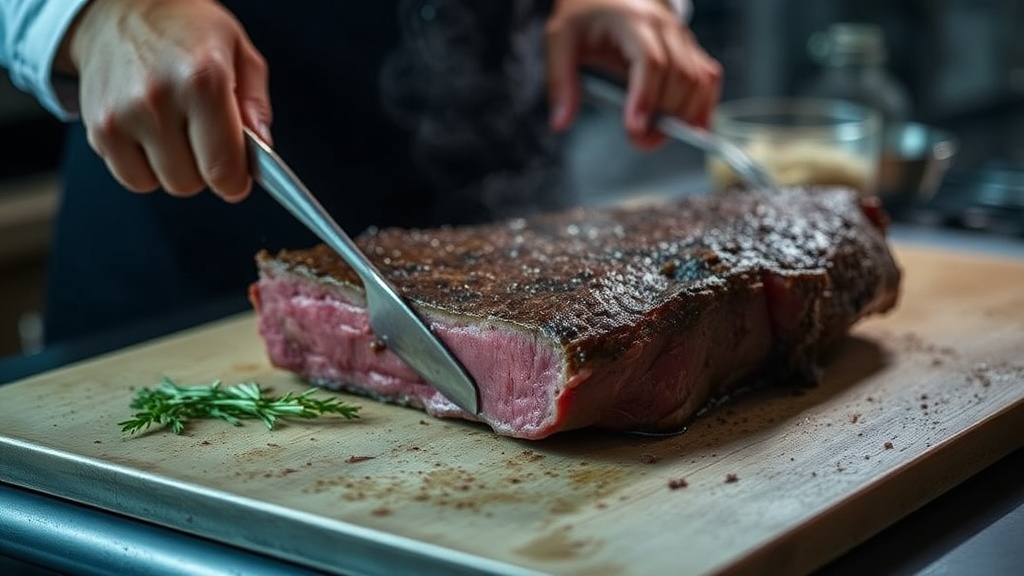
Why Resting Meat After Cooking Makes All the Difference

Quick Tip
Always let cooked meat rest for 5-10 minutes before slicing to allow juices to redistribute throughout the protein, ensuring every bite stays moist and flavorful.
The Science Behind Juicier Meat
This post explains the mechanics of resting cooked meat and provides specific timing guidelines for different cuts. Understanding this step transforms good cooking into exceptional results—meat that retains its natural juices rather than flooding the cutting board.
What Happens During Cooking
When meat hits a hot pan, grill, or oven, muscle fibers contract and tighten. This contraction forces moisture toward the center of the cut. Slicing immediately after cooking releases these pooled juices, leaving the exterior dry and the interior depleted. A 2012 study from the University of Kentucky confirmed that steaks rested for 10 minutes retained 7% more moisture than those cut immediately.
How Resting Works
As meat rests away from heat, the internal temperature continues to rise—a phenomenon called carryover cooking. A 2-inch ribeye pulled from a 450°F oven at 125°F will climb to 133°F after 10 minutes of resting. This gradual temperature increase allows muscle fibers to relax and redistributes juices evenly throughout the protein structure.
Specific Resting Times by Cut
- Steaks and chops (1–2 inches thick): 5 to 10 minutes. Pull from heat at 125°F for medium-rare; target 130–135°F after resting.
- Whole roasted chicken or turkey: 20 to 30 minutes. Remove from oven at 160°F; carryover brings breast meat to 165°F.
- Pork loin or tenderloin: 10 to 15 minutes. Target 140°F at removal; rest to 145°F.
- Large roasts (brisket, prime rib): 30 to 60 minutes. These retain heat longest due to mass and require extended redistribution.
Temperature Targets and Carryover
Carryover cooking typically raises internal temperature by 5 to 10 degrees, depending on thickness and cooking method. A whole beef tenderloin roasted at 275°F will see a 10-degree rise. A thin pork chop seared in a cast-iron skillet may only rise 3 to 5 degrees. Use an instant-read thermometer and track both removal and final temperatures.
Practical Resting Technique
Transfer cooked meat to a cutting board or warm plate. Tent loosely with aluminum foil—tight wrapping traps steam and softens crusts. Do not cover thick cuts like brisket or pork shoulder; the exterior bark requires air circulation to remain intact. Position the meat in a draft-free area away from cold surfaces.
"Resting isn't passive—it's the final stage of cooking. The meat finishes, the juices settle, and the texture sets." — Thomas Keller, The French Laundry Cookbook
What Happens If You Skip It
A 12-ounce New York strip sliced straight from the pan loses approximately 10 tablespoons of fluid within 30 seconds. The same steak, rested properly, releases less than 4 tablespoons. That difference determines whether the meat tastes succulent or desiccated.
Resting requires patience, but the data confirms its value. Track temperatures, respect the timeframes, and serve meat at its optimal state.