Why Precision Tech Actually Makes You a Better Cook (Not Lazier)

Let's look under the hood of what precision actually does to a cook.
I've watched this debate play out in a dozen kitchens: someone brings in a sous vide circulator or a digital probe, and the old-guard line cook rolls their eyes. "That's cheating. Real cooks feel it." And then I've watched that same line cook send out a chicken breast at 170°F because they "felt" it was done — dry as chalk, because feeling isn't knowing.
Here's what I actually believe after two decades of cooking and photographing food: precision tech is the fastest path to intuition. Not a replacement for it. The numbers are training wheels, but not the embarrassing kind — the kind that teach your body what balance actually feels like before you take them off.
The Thermometer Is a Teacher, Not a Crutch
The reason "it feels hot enough" fails isn't that cooks are bad at estimating temperature. It's that proteins don't care about your feelings — they respond to physics.
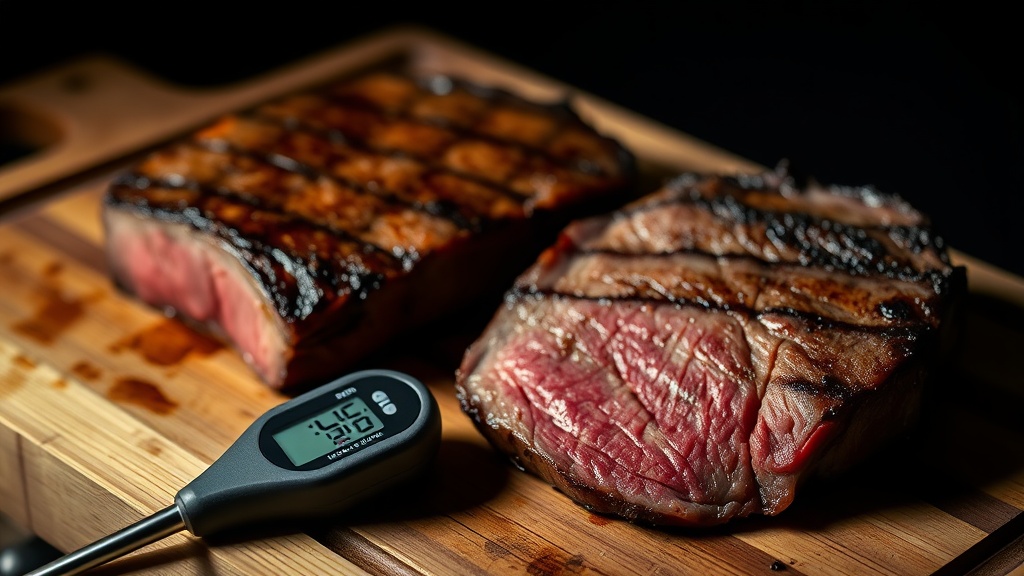
Myosin, the protein in muscle fiber responsible for texture, begins denaturing somewhere in the low-to-mid 120s°F. Actin — the other major muscle protein — starts its own denaturation process above roughly 150°F. This is why a steak pulled at 125°F (rare) has that yielding, almost buttery texture: myosin has started to set but actin is largely intact. Push into the 160s°F, and both proteins are substantially denatured — which is why the texture reads completely different. The key word is "substantially": denaturation is a gradual process, not a switch, and these numbers are thresholds where the texture shift becomes perceptible, not absolute collapse points. The difference across that range is 35 degrees. You cannot feel 35 degrees with your thumb.
But here's what happens when you use a probe thermometer obsessively for six months: you start to see the signs. The color of the surface fat rendering. The subtle change in resistance when you press the meat. The way the muscle fibers pull away from bone at a specific point. The thermometer teaches you to correlate those visual and tactile cues with actual internal temperature. Eventually, you need the probe less — not because you got lucky, but because you've built a mental model off verified data.
The sequence, if you want to be deliberate about it:
- Use the probe every single time for the first three months. Log the temps and your observations.
- Make predictions before you insert it. Write them down.
- Compare. You'll be off by 8°F, then 5°F, then 3°F.
- That's calibration. You're training the tool that matters most: your judgment.
Scales Kill Baking Guesswork — and Then Give You Creative Control
Baking is the discipline that converts the most kitchen skeptics to precision converts. Volume measurement for flour is notoriously inconsistent — a cup of all-purpose flour can weigh anywhere from 120 to 165 grams depending on how it's scooped, the humidity that day, and whether you tapped the measuring cup. That 45-gram swing is the difference between a tender crumb and a dense brick.
Baker's percentages solve this by anchoring everything to flour weight. Flour is always 100%. Hydration — the weight of water divided by flour weight — determines dough character. A standard French baguette runs around 75% hydration. A bagel dough sits around 55-58%. A ciabatta can push to 80%+ and requires a completely different handling technique because wet doughs behave differently at every stage.
When you bake by weight and percentage, you learn these relationships directly. A 68% hydration sourdough feels a specific way in your hands. When you scale it to 78%, you feel the difference — more extensible, stickier, harder to shape. You understand why it's harder to shape, because the formula change maps directly to the physics of gluten development in the presence of more water.
Cook's Illustrated ran reproducibility tests across home bakers and found consistent bakers using weight measurement produced results with dramatically smaller variance in rise, texture, and crust color. Not because the weighers were more talented — because they were comparing against a fixed reference point. Once you have a working formula documented precisely, then you can start varying it: swap in 15% whole wheat, drop the hydration, add a touch of honey. Every adjustment is legible because you know what you started from.
Sous Vide Is a Science Lab That Lives in Your Kitchen
I have a complicated relationship with sous vide. I've seen it deployed as pure laziness — bags of protein floating in thermal baths for hours while the cook ignores them and scrolls their phone. That's not what I'm talking about.
What sous vide actually gives you is visible proof of protein science. If you want to understand what temperature does to a chicken breast, do this experiment once: cook two identically-sized breasts simultaneously — one at 140°F for 90 minutes, one at 160°F for the same time. Slice them next to each other. One will be ivory-white, firm but moist, with a texture that reads almost like a fresh mozzarella — yielding and clean. The other will be white-white, dense, and noticeably drier.
That side-by-side is the Modernist Cuisine principle made tangible in your home kitchen. You've just demonstrated protein denaturation across a 20-degree range. The actin in the 160°F breast is well into denaturation; the actin in the 140°F breast has barely crossed threshold. You can see the chemistry on the plate.
Kenji López-Alt's thermal testing work at Serious Eats — methodical, obsessive, and deeply important — is built on this same logic. Don't take the result on faith. Test it yourself, document what you observe, and now you have empirical knowledge that transfers. When you're searing a duck breast in a hot pan and you don't have a circulator anywhere near you, you know what 140°F internal temperature looks like from the outside — the color of the fat rendering at the edge, the slight give when pressed at the thickest point. Because you've seen it dozens of times.
Fermentation Data: Demystifying the "Magic"
Fermentation feels like alchemy until you understand the two variables that control everything: salt concentration and temperature.
Salt concentration for most vegetable ferments sits in the 2–5% range by weight — and where you land in that window matters. Drop too low and you're creating conditions where unwanted organisms can compete with the lactobacillus you want; push significantly higher and you start slowing the ferment, sometimes to a crawl. The sweet spot most recipes converge on, roughly 2–3% salt by vegetable weight (or a 3–5% brine solution), keeps the environment selective without strangling activity. These aren't hard cutoffs — every ferment, temperature, and salt type varies — but measuring precisely gives you a reproducible baseline to work from. A kitchen scale and a quick percentage calculation takes 30 seconds and removes most of the uncertainty.
Temperature is the other lever. Lactobacillus species vary, but most active fermentation happens somewhere in the 65–80°F range, with the exact sweet spot depending on strain and what flavor profile you're after. At cooler temperatures — refrigerator range — fermentation slows dramatically, which is exactly why cold fermentation for bread dough and slow kimchi ferments develop more depth and complexity over time. Push into the mid-80s°F and above and you're accelerating the process, which can introduce off-flavors if you're not careful.
Fermentation monitoring apps — and even simple pH strips — give you feedback that was invisible before. A kimchi ferment at room temperature will gradually acidify over days to weeks, dropping from near-neutral toward the 3.5–4.5 range as lactic acid accumulates. Tracking that curve, even loosely, teaches your palate what to listen for: the early fizzy brightness of a young ferment, the deepening sourness as acidity builds. In my experience, you start correlating those flavor stages to the numbers after you've watched a few batches through. The data doesn't replace tasting — it gives the tasting context.
Koji is the extreme example. The Aspergillus oryzae mold that produces koji — used in miso, sake, and increasingly in contemporary Western applications — operates best in a tight temperature band (86-95°F) and high humidity (75-85%). Without monitoring, you're guessing. With a probe thermometer and a hygrometer in a modified cooler or incubation box, you're farming. That's not removing the magic. That's finally understanding where the magic actually lives.
The Philosophical Pivot: Numbers Into Intuition
There's a version of precision cooking that becomes a crutch. You've seen it — the cook who cannot function without consulting their phone app before every decision, who feels paralyzed if the probe is in the drawer. That's not what I'm advocating.
The goal is to use the numbers until they're inside you.
A musician learning jazz starts with written notation, chord theory, scale patterns. They practice slowly, then fast, then with a metronome, then without. Eventually — if they've done the work — the theory doesn't feel like theory anymore. It's just how they hear music. The structure is internalized.
That's what precision tech does at its best. You use a thermometer obsessively until the temperature windows are in your hands. You weigh every bake until the hydration percentages are in your feel. You run the sous vide experiments until you understand exactly what you're trying to approximate when you're roasting in a conventional oven.
Spring is the right time for this kind of thinking — the season of delicate proteins and new-growth vegetables, the time of year when the margin for error shrinks. Asparagus cooked two minutes too long. A halibut fillet pushed five degrees past ideal. These are errors that taste different from winter's forgiving braises. Precision isn't just useful right now; it's specifically calibrated to the demands of the season.
I'll say this plainly: the best kitchen tech is the one that makes you understand food better. Not the prettiest circulator, not the most expensive scale — the tool that, after you've used it a hundred times, leaves you with a mental model of what's actually happening in the pan, on the grill, in the crock.
After that, you can leave the tools in the drawer.
Technique doesn't lie.