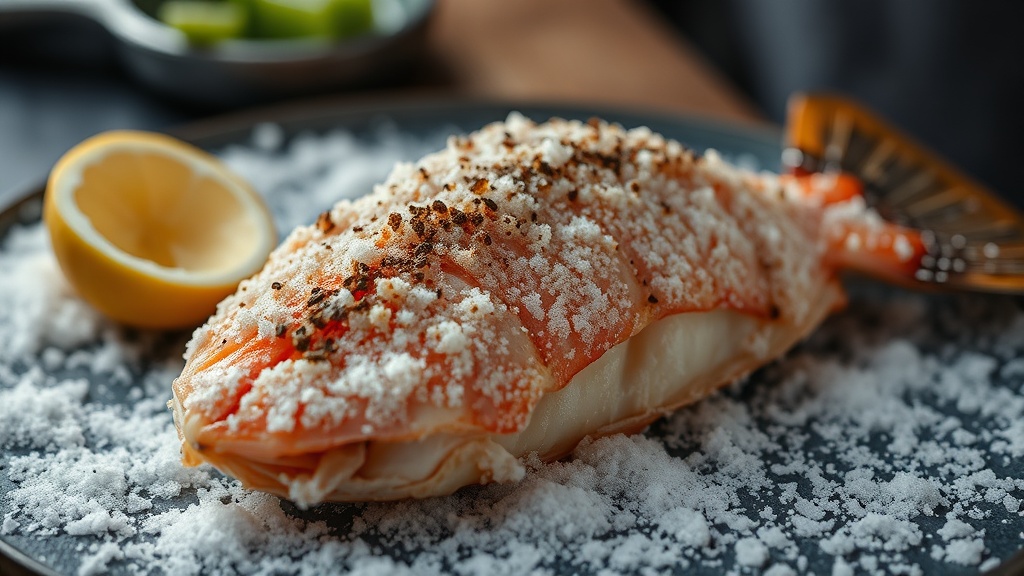
The Salt Crust Secret: Elevating Seafood with Mineral Magic

Quick Tip
Use a mixture of coarse sea salt and egg whites to create a sturdy, flavorful dome that seals in steam.
The Architecture of Flavor: The Salt Crust Method
Imagine a whole sea bass resting on a marble countertop, its scales still glistening. You aren't just seasoning it; you are constructing a pressurized, mineral-rich chamber designed to lock in every drop of moisture. A salt crust is not merely a coating—it is a structural tool that uses thermal mass to ensure even heat distribution while preventing the delicate proteins of the fish from drying out in the oven's dry air.
The Technical Foundation
To execute this properly, you must move beyond standard table salt. The goal is to create a granular, insulating shell. Use Kosher salt or Maldon sea salt for its larger crystal size, which provides better structural integrity. If you use fine salt, the crust will collapse into a dense, overly salty paste that clings to the skin rather than forming a protective dome.
For a professional-grade crust, follow this specific assembly sequence:
- The Aromatics: Lay a bed of fresh sprigs—think thyme, rosemary, or lemon verbena—on a baking sheet lined with parchment paper. This prevents the fish from sticking and adds a subtle, steamed fragrance.
- The Buffer: Place your protein (a whole snapper, sea bass, or even a thick salmon fillet) atop the herbs. Brush the skin lightly with high-quality olive oil or melted clarified butter.
- The Brine Mix: In a large bowl, combine 3 to 4 pounds of coarse sea salt with 3 or 4 egg whites. The egg whites act as a binding agent, turning the salt into a "wet sand" consistency that can be molded around the fish.
- The Encasement: Pack the salt mixture over the fish, ensuring there are no air pockets or gaps. A seamless seal is vital for maintaining internal steam pressure.
Precision Execution
Preheat your oven to 400°F (200°C). The thermal density of the salt means the cooking time will be slightly longer than traditional roasting, but the interior temperature will remain incredibly stable. For a 2-pound fish, aim for approximately 25–30 minutes. The crust should feel hard and set to the touch before you attempt to crack it.
When the fish is ready, do not use a knife to hack through the shell. Instead, use the back of a heavy spoon or a small mallet to gently crack the crust. This reveals a perfectly steamed, succulent fillet that has been seasoned with surgical precision. To further enhance the visual and textural profile of your dish, consider pairing it with a bright, acidic element, much like the precision found in unlocking golden color and aroma through high-quality spices.
"The salt crust is the ultimate marriage of physics and flavor; it is a controlled environment that protects the delicate essence of the sea."