The Physics of Silk: Why Emulsification Is the Most Important Technique in Your Kitchen

There's a moment in every vinaigrette that separates the cooks who understand emulsification from the ones who just shake a jar and hope.
It's the moment you start drizzling oil into acid and the mixture shifts from two angry liquids refusing to cooperate into something new—a third substance, silky and cohesive, that didn't exist thirty seconds ago.
That moment is physics. And it's the single most useful thing you can learn in a kitchen.
What's Actually Happening in the Bowl
Oil and water don't mix. You learned that in grade school. But what nobody told you is why they don't mix—and more importantly, why certain ingredients can force them into a truce.
Fat molecules are hydrophobic. They literally flee from water. Acid—vinegar, citrus juice—is mostly water. When you pour oil into vinegar and whisk, you're breaking the oil into tiny droplets suspended in the acid. Left alone, those droplets will find each other and coalesce back into a layer. This is called coalescence, and it's the enemy of every sauce you've ever watched break.
An emulsifier—mustard, egg yolk, lecithin, garlic paste—parks itself at the boundary between each oil droplet and the surrounding water, acting as a molecular bouncer. One end of the emulsifier molecule is attracted to fat, the other to water. It holds the droplet in place and prevents reunification.
That's it. That's the whole trick. Every creamy sauce you've ever loved is just this physics repeated at scale.
The Three Emulsions You Need to Master
Forget the textbook taxonomy. In a home kitchen, there are three emulsions that will transform your cooking overnight:
1. The Permanent Vinaigrette
Most vinaigrettes break within minutes because people skip the emulsifier or add oil too fast.
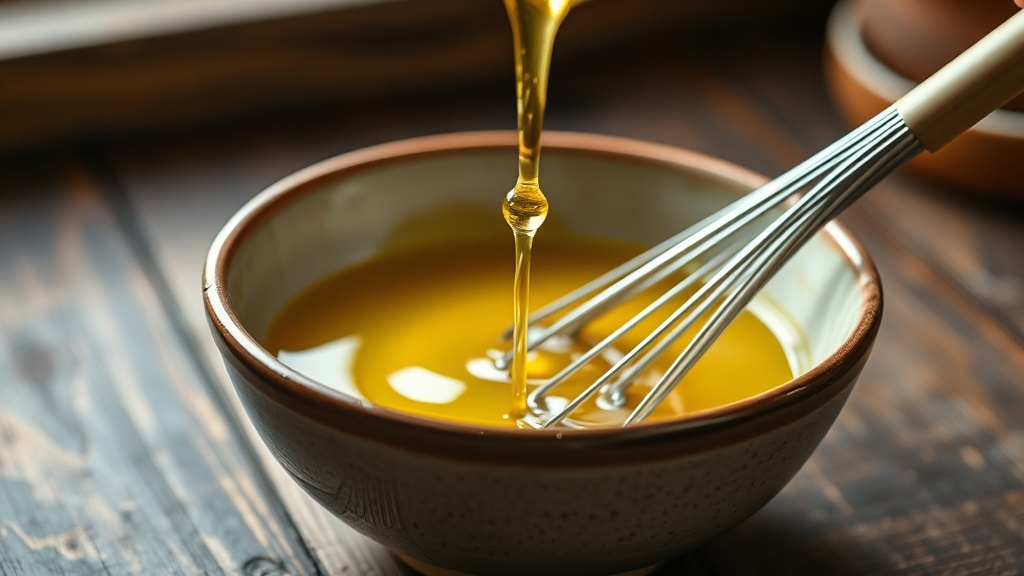
Here's the fix: start with a teaspoon of Dijon mustard in the bottom of a bowl. Add your acid—sherry vinegar is my go-to, red wine vinegar if I'm feeling direct. Whisk the mustard into the acid until it's smooth. Then drizzle oil in a thin, steady stream while whisking constantly.
The ratio matters: roughly 3 parts oil to 1 part acid, adjusted to your palate. But the speed of addition matters more than the ratio. Too fast, and the mustard can't coat enough droplets. You get a broken, greasy mess.
A well-made vinaigrette should coat the back of a spoon lightly and hold together in the fridge for days. If yours separates after twenty minutes, you rushed the oil.
2. The Pan Sauce Emulsion
You deglaze a pan with wine or stock, reduce it, then swirl in cold butter. That butter isn't just adding richness—it's creating an emulsion. The milk solids and water in the butter act as emulsifiers, binding the fat into the liquid fond.
The critical variable is temperature. Too hot, and the butterfat renders out and pools on the surface. Too cool, and the butter just sits there in chunks. You want the pan off direct heat, still warm but not screaming. Swirl the butter in pieces, moving the pan constantly. The sauce should turn glossy and slightly thickened—what the French call monté au beurre.
I've watched hundreds of home cooks nail the deglazing and reduction, then blow it at the butter stage because they leave the pan on high heat. Pull it off the burner. Let residual heat do the work.
3. Aioli (Real Aioli, Not Flavored Mayo)
Traditional aioli from Provence is garlic pounded in a mortar with salt, then oil worked in drop by drop until the mixture emulsifies from the garlic's natural lecithin and the mechanical force of the pestle.
No egg. No blender. Just garlic, oil, salt, and patience.
Start with four or five fat cloves and a generous pinch of coarse salt. Pound them into a paste—truly a paste, no chunks. Then add oil a few drops at a time, grinding in a circular motion. After the first tablespoon of oil is incorporated, you can increase to a thin drizzle. The garlic paste itself is the emulsifier here, and it's remarkably effective if you don't rush.
The result is pungent, thick, and alive in a way that Hellmann's-with-garlic-powder will never be. Spread it on grilled bread, drop a spoonful into fish soup, or use it as the base for a composed vegetable plate. It keeps for two days in the fridge, though it rarely lasts that long.
Why Emulsions Break (And How to Save Them)
Every broken emulsion fails for one of three reasons:
- Too much fat, too fast. The emulsifier gets overwhelmed. Solution: slow down. With a broken vinaigrette, start over with fresh mustard in a clean bowl and whisk the broken mixture in gradually as if it were your oil.
- Wrong temperature. Butter sauces break when overheated. Hollandaise curdles when the eggs get too hot. Aioli seizes in a cold kitchen. Most emulsions want to be worked at a moderate, comfortable temperature—not cold, not screaming.
- Insufficient emulsifier. If your dressing won't hold, add more mustard. If your mayo won't thicken, another yolk. Don't be stingy with the thing doing the actual work.
The rescue technique is universal: take a small amount of fresh emulsifier in a clean vessel—a teaspoon of mustard, a yolk, a tablespoon of warm water—and slowly whisk the broken sauce into it. You're rebuilding the emulsion from scratch, using the broken sauce as your fat source. It works almost every time.
The Deeper Lesson
Emulsification teaches you something fundamental about cooking that no recipe can: process matters more than ingredients.
The exact same olive oil, the exact same vinegar, the exact same mustard will produce either a gorgeous, stable vinaigrette or a greasy puddle depending entirely on how you combine them. The ingredients don't change. Your technique does.
This is true across the entire kitchen. A steak seared in a ripping-hot pan versus a lukewarm one. Bread dough kneaded to the windowpane stage versus abandoned early. Caramel taken to 340°F versus 310°F. The materials are identical. The process—the timing, temperature, and mechanical energy you apply—creates the result.
Once you internalize that, you stop being a recipe follower and start being a cook.
Go make a vinaigrette tonight. Not from a bottle. From a bowl, a whisk, and five minutes of attention. Watch the moment it comes together. That's not just dinner prep—that's you understanding how food actually works.
Stay hungry, friends.