The Architecture of Alliums: Why Ramps, Green Garlic, and Spring Onions Deserve More Than a Garnish

Every March, a quiet hysteria sweeps through the kitchens I respect most. Chefs who normally maintain stoic composure start texting each other single-word messages: "Ramps."
I get it. I've been that person, crouching in a farmers' market at 7 AM with a notebook in one hand and a fistful of muddy wild leeks in the other. But here's the thing that bothers me about ramp season, and spring allium season more broadly: we've turned these ingredients into garnishes. Pretty little ribbons on top of a finished plate. A sprinkle of green to signal "seasonal." That's not cooking. That's decoration.
Ramps, green garlic, and spring onions deserve to be the load-bearing walls of a dish, not the window dressing. And if you learn to treat them that way, you'll cook better food this month than you have all winter.
The Structural Problem with Spring Cooking
Winter cooking has backbone. Braises, stews, roasted roots—everything has heft and thermal mass. Then spring arrives and people panic. They start making "light" food, which usually means under-seasoned salads and pasta with a whisper of green things on top.
The issue isn't the ingredients. Spring alliums are some of the most structurally versatile aromatics you'll encounter all year. The problem is that cooks treat them like a seasonal accent when they should be treating them like a foundation.
Think of it this way: in winter, your allium foundation is onions, shallots, and garlic. You build every braise and sauce on that trinity. But when ramps and green garlic show up, most people just... scatter them raw on top of things. You wouldn't build a house by placing the framing on the roof.
Ramps: The Whole Building, Not Just the Facade
A ramp is two ingredients pretending to be one. The white bulb at the base is pungent, garlicky, and dense—closer to a shallot in behavior when cooked low and slow. The broad green leaf is delicate, almost herbal, and wilts in seconds under heat.
Most recipes ignore this duality. They tell you to "sauté the ramps" as if the bulb and the leaf cook at the same rate. They don't. Not even close. Treating them as one ingredient is like using the same mortar for your foundation and your roofline.
Here's how I handle them:
The bulbs get sliced thin and sweated in olive oil or butter over low heat for eight to ten minutes, until they're translucent and sweet. This is your base layer—the structural slab. Use them anywhere you'd use slowly cooked shallots: risotto foundations, the start of a pan sauce, folded into a frittata before the eggs go in.
The leaves get one of two treatments. Either they go in raw at the very end—torn and tossed with warm pasta, draped over a finished soup—or they get blitzed into a vivid green oil or pesto. The key is that leaves and bulbs never hit the pan at the same time. Separate construction phases.
My favorite ramp dish right now is dead simple. Sweat the bulbs in butter until soft. Add arborio rice, toast it for two minutes, then build a risotto with good chicken stock. In the last minute of cooking, stir in a spoonful of ramp leaf pesto and a handful of torn raw leaves. Finish with parmesan and black pepper. The bulbs give you depth in the foundation. The leaves give you a bright, almost wild hit on top. Same plant, two structural roles.
Green Garlic: The Most Underused Ingredient in America
If ramps are the celebrity of spring alliums—overhyped but genuinely talented—green garlic is the session musician who makes every band sound better.
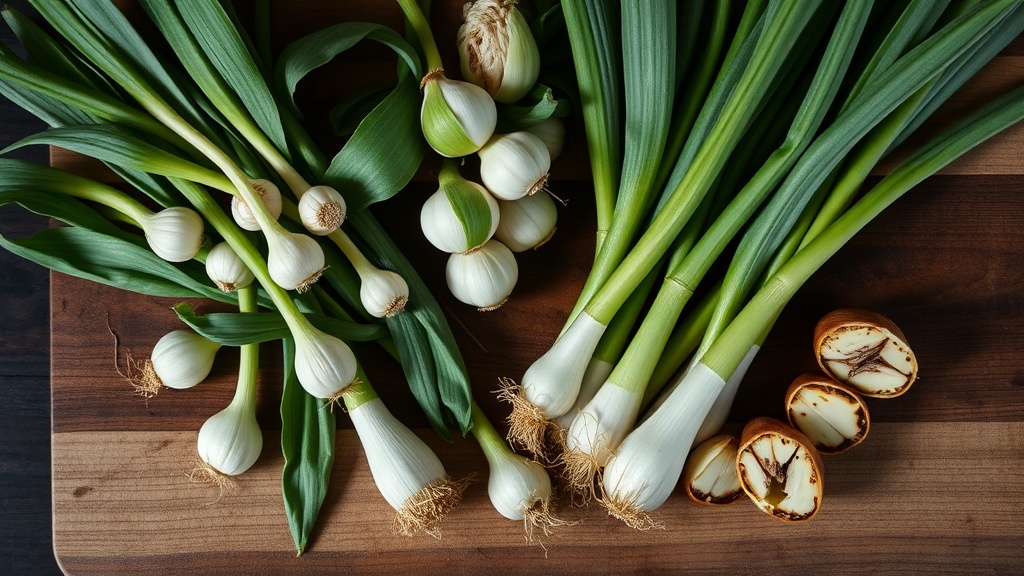
Green garlic is just immature garlic, pulled before the bulb fully forms. It looks like a scallion with ambitions. The flavor sits in a beautiful middle ground: more complex than a scallion, less aggressive than a cured garlic clove. It has sweetness and depth without that acrid burn you get from raw mature garlic.
I use it as a complete replacement for regular garlic in almost every dish from mid-March through May. Not as an addition. A replacement. Mince the white and pale green parts and use them wherever your recipe calls for garlic. The result is gentler, rounder, and more interesting than the dried cloves sitting in your pantry.
But where green garlic really earns its place is in applications where raw garlic would be too harsh. Stir it into a compound butter for grilled fish. Pound it into a spring aioli—real aioli, mortar and pestle, the way I described in my emulsification piece. Fold it into scrambled eggs in the last thirty seconds of cooking. In every case, you get garlic's aromatic presence without the aggression.
The window for green garlic at farmers' markets is roughly six weeks. If you see it, buy more than you think you need. It keeps wrapped in a damp towel in the fridge for a week, and it freezes well if you mince it first and pack it into ice cube trays with a little olive oil.
Spring Onions: The Quiet Professional
Spring onions don't get the Instagram treatment that ramps do. Nobody's posting stories about their spring onion haul. And that's precisely why I trust them.
A spring onion is a regular onion pulled young, before the papery skin forms and the layers dry out. The flavor is sweeter and milder than a storage onion, with a higher water content that makes it behave differently under heat.
Here's my move: halve them lengthwise and char them cut-side down in a screaming-hot cast iron pan with just a film of neutral oil. Don't touch them for four minutes. You want a deep, almost black char on the flat side while the interior stays juicy and barely cooked. Then hit them with a squeeze of lemon, flaky salt, and a drizzle of good olive oil.
That's not a side dish. That's the main event. Serve them next to a piece of simply grilled fish or a slab of good bread with ricotta, and you've got a meal that actually tastes like March.
The char is doing critical work here. It's the Maillard reaction creating a structural crust—a load-bearing exterior—that gives your teeth something to work through before hitting the sweet, almost custard-like interior. Without that char, a cooked spring onion is just soft and sweet. With it, you have contrast, tension, and a reason to pay attention.
The Compound Approach: Building with All Three
The real payoff comes when you use spring alliums together, each playing a different structural role in the same dish.
Last week I made a simple pasta that used all three. I sweated ramp bulbs and minced green garlic in olive oil as the base. Cooked orecchiette until just short of al dente, then finished it in the pan with the allium base and a splash of pasta water to build a silky emulsion. Off heat, I tossed in torn ramp leaves and topped each bowl with a charred spring onion half.
Three alliums. Three structural roles. The ramp bulbs and green garlic formed the aromatic foundation—the slab and framing. The ramp leaves provided a bright, herbaceous finish—the paint and trim. The charred spring onion delivered textural contrast on top—the facade that catches your eye.
Total cost: maybe six dollars in produce, plus a box of pasta. Total time: twenty-five minutes. But the depth of flavor made it taste like something a restaurant would charge twenty-two dollars for, because the architecture was sound.
A Note on Sourcing and Sustainability
One thing I won't gloss over: ramps are wild-foraged, and overharvesting is a real problem. A ramp plant takes five to seven years to reach maturity from seed. When you buy ramps, look for vendors who harvest leaves only or take just one leaf per plant, leaving the bulb to regenerate. If your farmers' market vendor is selling huge bundles of uprooted ramps with roots attached, ask questions. Responsible foragers exist—seek them out.
Green garlic and spring onions, by contrast, are cultivated and abundant. If ramps are hard to find or expensive in your area, a combination of green garlic and spring onions will get you ninety percent of the way there.
The Takeaway
Spring alliums aren't garnishes. They're not a seasonal signal to scatter on top of a dish so it looks like you care about the calendar. They are foundational ingredients—aromatics with enough depth and complexity to anchor an entire meal if you give them the structural respect they deserve.
Separate the parts. Cook each component according to its nature. Build from the base up. The same principles that make a building stand make a dish sing.
Stay hungry, friends.