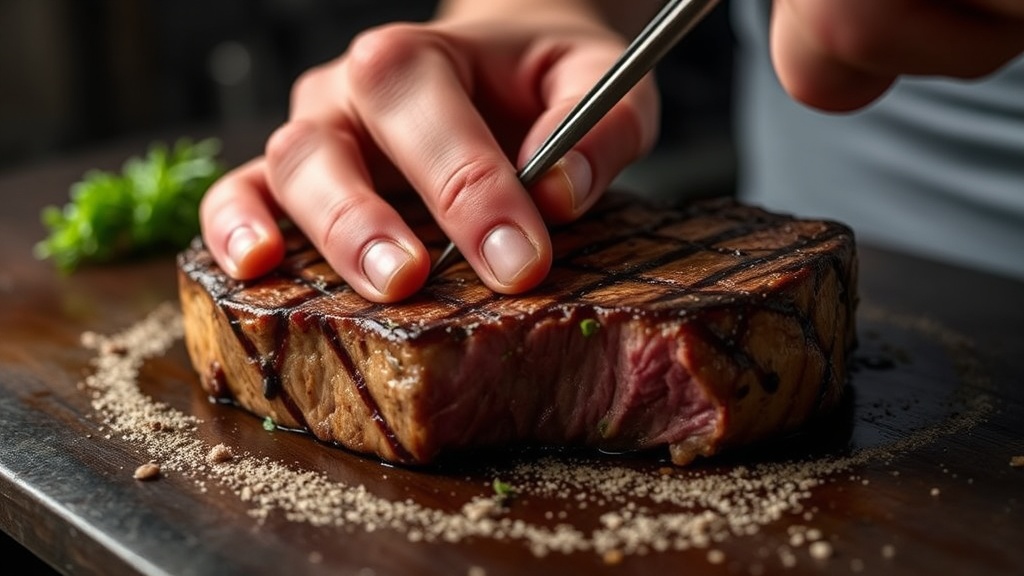
Master the Finger Test: Check Steak Doneness Without a Thermometer

Quick Tip
Touch your thumb to each finger to create different tension levels in your palm muscle—index for rare, middle for medium-rare, ring for medium, and pinky for well-done.
The Science Behind the Touch Test
The finger test allows you to gauge steak doneness by comparing the resistance of the meat to the firmness of your palm. This method works because the muscle groups in your hand contract in direct correlation to how proteins tighten as they cook. With practice, the touch test delivers accuracy within 5°F of a digital probe thermometer.
How to Calibrate Your Hand
Hold one hand relaxed, palm facing up. With the index finger of your other hand, press the thick fleshy pad at the base of your thumb. This baseline softness represents raw meat. Now touch your thumb to each finger sequentially and feel the same spot:
- Thumb to index finger: Soft, yielding pressure. This equals rare (120°F–125°F internal temperature).
- Thumb to middle finger: Slight resistance with noticeable spring-back. This equals medium-rare (130°F–135°F).
- Thumb to ring finger: Firm with moderate bounce. This equals medium (135°F–145°F).
- Thumb to pinky finger: Dense, unyielding surface. This equals well-done (155°F–165°F).
Execution Technique
Remove the steak from direct heat before testing. Press the center of the thickest portion with your index finger, not your thumb. Compare that resistance to your calibrated palm. For a 1.5-inch-thick ribeye cooked over 450°F direct heat, expect 3 minutes per side to reach medium-rare using the thumb-to-middle-finger reference.
Critical Variables
Muscle fiber density affects firmness. A grass-fed filet mignon feels softer at 130°F than a Prime-grade strip steak at the same temperature due to lower intramuscular fat content. Bone-in cuts like T-bone retain heat differently—test the strip side, not near the bone, for accurate readings.
Rest the steak 5–7 minutes before cutting. Carryover cooking raises internal temperature 5°F, moving a medium-rare reading into medium territory if sliced immediately.
Common Mistakes
Testing while the steak sits in a screaming hot pan leads to false positives—the exterior crust feels firm while the center remains undercooked. Pressing with the thumb instead of the index finger introduces bias from your own grip strength. For consistent results, test at room temperature with relaxed hands; cold hands produce tighter readings that skew toward overcooking.
Professional kitchens rely on this technique because thermometers pierce muscle fibers and release juices. The finger test preserves the steak's integrity while delivering precise, repeatable results after ten to fifteen practice attempts.