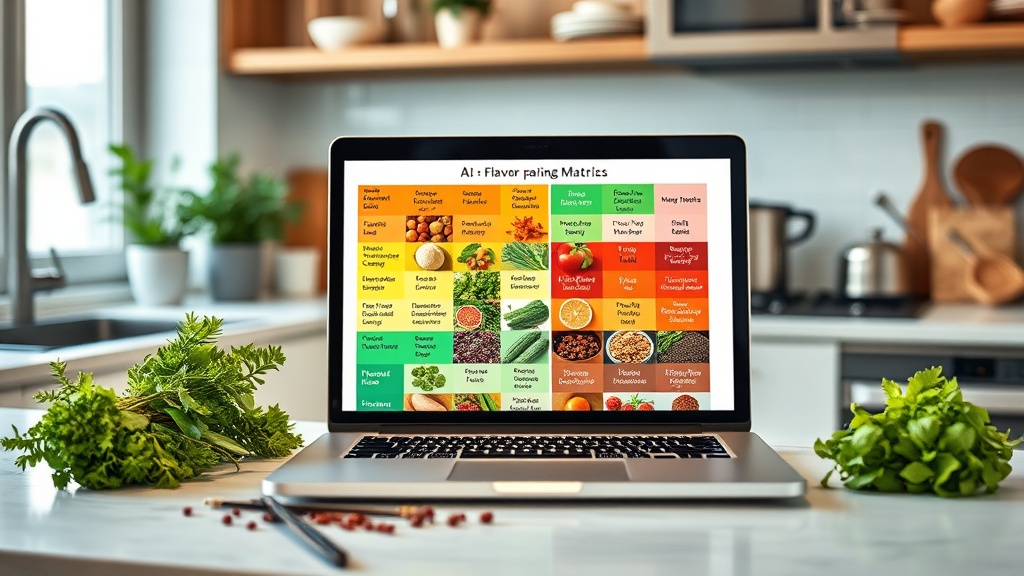
How to Use AI Flavor Pairing Tools to Elevate Your Home Cooking

Ever wondered if a computer could suggest the perfect ingredient match for your next dinner? The answer is yes – and it’s easier than you think.
\n\nAI flavor pairing is the newest kitchen sidekick, turning data from thousands of recipes into surprising, palate‑pleasing combos. In this guide I’ll walk you through picking a tool, setting up a workflow, and translating the algorithm’s output into a dish you’ll actually want to eat.
\n\nWhat is AI flavor pairing, and why should home cooks care?
\nAt its core, AI flavor pairing analyzes chemical compounds, historical usage, and consumer preferences to predict which ingredients harmonize. Think of it as a data‑driven flavor compass that points you toward unexpected yet delicious pairings.
\n\nWhile restaurants have been experimenting with it for menu development, the technology has finally become affordable for the home kitchen. The result? Faster idea generation, fewer dead‑end experiments, and a chance to surprise yourself (and your guests) with novel flavor bridges.
\n\nWhich AI tools are actually usable for a home kitchen?
\nNot every platform is built for the hobbyist. Below are the three that balance price, usability, and scientific rigor:
\n- \n
- FlavorPrint (flavorprint.com) – a subscription service that lets you input up to five ingredients and returns a ranked list of complementary foods. Their API is free for personal projects. \n
- Chef Watson (IBM Research) – the classic IBM experiment now offered as a cloud service. It provides a visual “flavor graph” and lets you tweak constraints like dietary restrictions. \n
- Foodpairing® (foodpairing.com) – a commercial tool with a sleek UI, perfect for visual learners. A free tier offers 10 queries per month. \n
All three pull from the same scientific backbone – the Flavour Network study that maps volatile compounds across hundreds of foods.
\n\nHow do I set up a simple AI flavor‑pairing workflow?
\nFollow these five steps, each of which takes under ten minutes:
\n- \n
- Choose your platform. I recommend starting with FlavorPrint’s free tier – sign up, verify your email, and you’ll land on a clean dashboard. \n
- Gather your base ingredients. Write down the main component of your dish (e.g., salmon, chickpeas, or dark chocolate). Include any constraints (vegan, low‑sodium, etc.). \n
- Enter the ingredients. Input them into the tool’s “Explore” field. Most platforms let you add up to five items; use the extra slots for spices you already love. \n
- Review the suggestions. The AI will output a list of 5‑10 pairings, each with a confidence score. Look for items you have on hand or can quickly source. \n
- Prototype the combo. Choose one pairing, sketch a quick recipe (e.g., salmon + miso‑glazed carrots + toasted hazelnuts), and test it in a 30‑minute trial run. Adjust seasoning and note the result. \n
Repeat the loop for each new dish. Over time you’ll develop a personal “AI‑enhanced pantry” of go‑to combos.
\n\nWhat are best practices for interpreting AI suggestions?
\n- \n
- Trust the score, but taste first. A high confidence rating means the algorithm sees strong chemical overlap, not that the combo will suit your palate. \n
- Consider texture. AI focuses on flavor compounds; pair a crunchy element with a soft one to balance mouthfeel. \n
- Mind cultural context. Some pairings (e.g., mango‑chili) are regionally beloved; if unfamiliar, test with a small portion. \n
- Document outcomes. Keep a notebook (digital or paper) of what worked and what didn’t. Over time you’ll train your intuition alongside the AI. \n
What common pitfalls should I avoid?
\nEven the smartest algorithm can lead you astray if you ignore a few basics:
\n- \n
- Over‑reliance on novelty. Not every bizarre combo is delicious. Use AI as a spark, not a rule. \n
- Ignoring ingredient quality. Fresh herbs, high‑grade olive oil, and ripe produce make any pairing shine. \n
- Skipping seasoning balance. Salt, acid, and fat are the three pillars of flavor; make sure your AI‑suggested dish respects them. \n
- Neglecting dietary limits. Double‑check that the tool hasn’t slipped in allergens or unwanted additives. \n
How can I integrate AI flavor pairing into weekly meal planning?
\nSet aside a “tech‑prep” slot on Sunday:
\n- \n
- Review your grocery list and note any staple proteins you’ll cook. \n
- Run each protein through your chosen AI tool to generate 3‑4 side‑dish ideas. \n
- Map the suggestions onto your calendar, balancing prep time and cooking complexity. \n
- When you shop, grab any exotic ingredients the AI recommends – they’re often the ones that make the dish pop. \n
This approach turns a chaotic week into a curated tasting adventure.
\n\nTakeaway
\nAI flavor pairing is no longer a futuristic gimmick; it’s a practical, affordable way to expand your culinary vocabulary. Pick a tool, follow the five‑step workflow, and let data‑driven pairings inspire your next home‑cooked masterpiece. As you experiment, you’ll discover that the best recipes often start with a single, algorithm‑suggested spark.
\n\nReady to try? I’ve linked a few of my favorite resources below. Happy pairing!
\n\nRelated Reading
\n- \n
- Zero‑Waste Kitchen: 7 Upcycled Ingredients to Elevate Your Dishes – learn how to repurpose pantry scraps before feeding them to AI. \n
- Why Precision Tech Actually Makes You a Better Cook (Not Lazier) – see how other tech tools complement AI pairing. \n
- The Physics of Silk: Emulsification – master the technique that often pairs with AI‑suggested sauces. \n
- The Return of the Saucier – explore why sauce is becoming the canvas for AI‑generated flavors. \n
Stay hungry, friends.